LOOKING FOR A CAR ACCIDENT LAWYER TO REPRESENT YOU?
What Types of Evidence Can Support Your Car Accident Claim?
What Evidence Do I Need for a Car Accident Claim?
To support a car accident claim, you need evidence showing how the collision happened, who was responsible, what injuries you suffered, and how those injuries affected you financially and personally. Strong documentation helps establish liability, demonstrate damages, and support a claim for fair compensation.
Important evidence includes:
- Police accident reports: Official documentation of the collision, involved drivers, witnesses, and the investigating officer’s observations.
- Photos and videos: Images of vehicle damage, visible injuries, road conditions, traffic signals, and the accident scene.
- Witness information and statements: Names, contact details, and accounts from people who saw the collision.
- Medical records: Emergency treatment records, diagnoses, imaging results, treatment plans, and rehabilitation records documenting your injuries and care.
- Financial documentation: Medical bills, prescription receipts, pay stubs and employer statements documenting lost wages, vehicle repair estimates, and other accident-related expenses.
- Additional evidence: Dashcam recordings, surveillance footage, vehicle data, and correspondence with insurance companies that may help resolve disputes.
Preserve original photos and recordings, keep copies of important documents, and maintain records of medical treatment and accident-related expenses. Because surveillance footage and other electronic evidence may be deleted or overwritten, identifying and preserving these materials promptly is important.
What Does the Evidence Need to Establish?
An injury claim against another driver generally needs support for responsibility, the connection between the collision and the claimed injuries, and the resulting losses. Different records address different parts of the claim.
- How did the collision happen, and who was responsible? Photographs, video recordings, witness accounts, crash reports, physical evidence, and relevant vehicle data.
- Did the collision cause or aggravate the claimed injuries? Medical history, examination findings, diagnostic records, symptom timelines, and medical opinions.
- What financial losses resulted? Medical bills, payment records, income documentation, repair estimates, and receipts.
- How did the injuries affect daily life and future needs? Treatment records, work restrictions, factual recovery notes, observations from others, and appropriate expert opinions.
A complete evidence file should address the specific claim rather than simply contain many documents. For example, a repair estimate may help document vehicle damage, but it does not establish the full extent of a physical injury.
Evidence About How the Collision Happened
Photographs, recordings, witness accounts, and police records can help explain the events surrounding a collision. Each source has strengths and limitations, so it is useful to consider them together.
Photographs and Video Recordings
Photographs and videos can document vehicle damage, roadway conditions, traffic controls, debris, and vehicle positions after impact. Their value often comes from context: a close-up photograph of damage shows something different from a wider image of the intersection.
For example, damage to the rear of one vehicle and the front of another may help establish the nature of a rear-end collision. However, damage patterns alone do not necessarily prove negligence. Photographs taken after a crash may not show where the vehicles were before impact or what either driver was doing.
Video recordings may provide additional information by showing vehicle movements, traffic signal changes, or events immediately before the collision. Camera angles, image quality, and incomplete recordings can limit what the footage establishes. A recording that begins after impact may document the aftermath without explaining how the crash occurred.
Preserve original photographs and recordings whenever possible. Edited clips and screenshots may omit context, while original files may retain information relevant to when and how they were created.
For practical guidance on photographing a collision and documenting the scene safely, see What to Do Immediately After a Car Accident .
Witness Accounts
Witnesses may provide information that the drivers could not clearly see. Someone near an intersection may have observed a traffic signal, while a driver traveling behind the vehicles may have seen a lane change.
Useful witness information includes:
- What the person saw or heard.
- Where the person was located.
- Whether anything obstructed their view.
- Which part of the event they observed.
- How to contact them for follow-up questions.
Distinguish observation from assumption. A witness who heard an impact and turned around afterward has different information from someone who watched the vehicles approach each other.
An account does not need to agree with every detail of another witness’s recollection to be useful. Differences should be examined rather than ignored or corrected through suggested answers. The significance of an account depends on what the witness observed and how it fits with the broader evidence.
What Can a Police Accident Report Help Establish?
A police accident report can help document the circumstances of a collision and identify additional sources of evidence. It may include information about the drivers and vehicles involved, insurance details, witnesses, roadway conditions, diagrams, citations, and the responding officer’s observations.
In Texas, qualifying crashes investigated by law enforcement are documented through the Texas Peace Officer’s Crash Report, commonly called Form CR-3. The Texas Department of Transportation’s crash report system provides information about requesting copies.
The report’s value extends beyond its description of the collision. For example, it may identify a witness whose contact information you did not collect or document roadway conditions that later changed.
However, a police report does not automatically establish legal fault. The investigating officer may not have witnessed the collision, and some information may come from drivers or witnesses rather than the officer’s direct observations. An assessment of contributing factors should therefore be considered alongside other evidence.
If the report contains a factual error or conflicts with other information, identify the specific discrepancy and preserve supporting records. A disagreement should be examined rather than treated as proof that either the report or the conflicting account is necessarily correct.
The Crash Report May Not Include the Entire Investigation
Obtaining the CR-3 does not necessarily mean you have every record created by law enforcement. TxDOT maintains the crash report, while requests for officers’ photographs, field notes, dashcam recordings, and other scene materials should be directed to the investigating agency. Availability and disclosure requirements may vary.
This distinction can matter when a report refers to information that does not appear in the copy you received.
How Can Medical Records Help Establish That an Accident Caused Your Injuries?
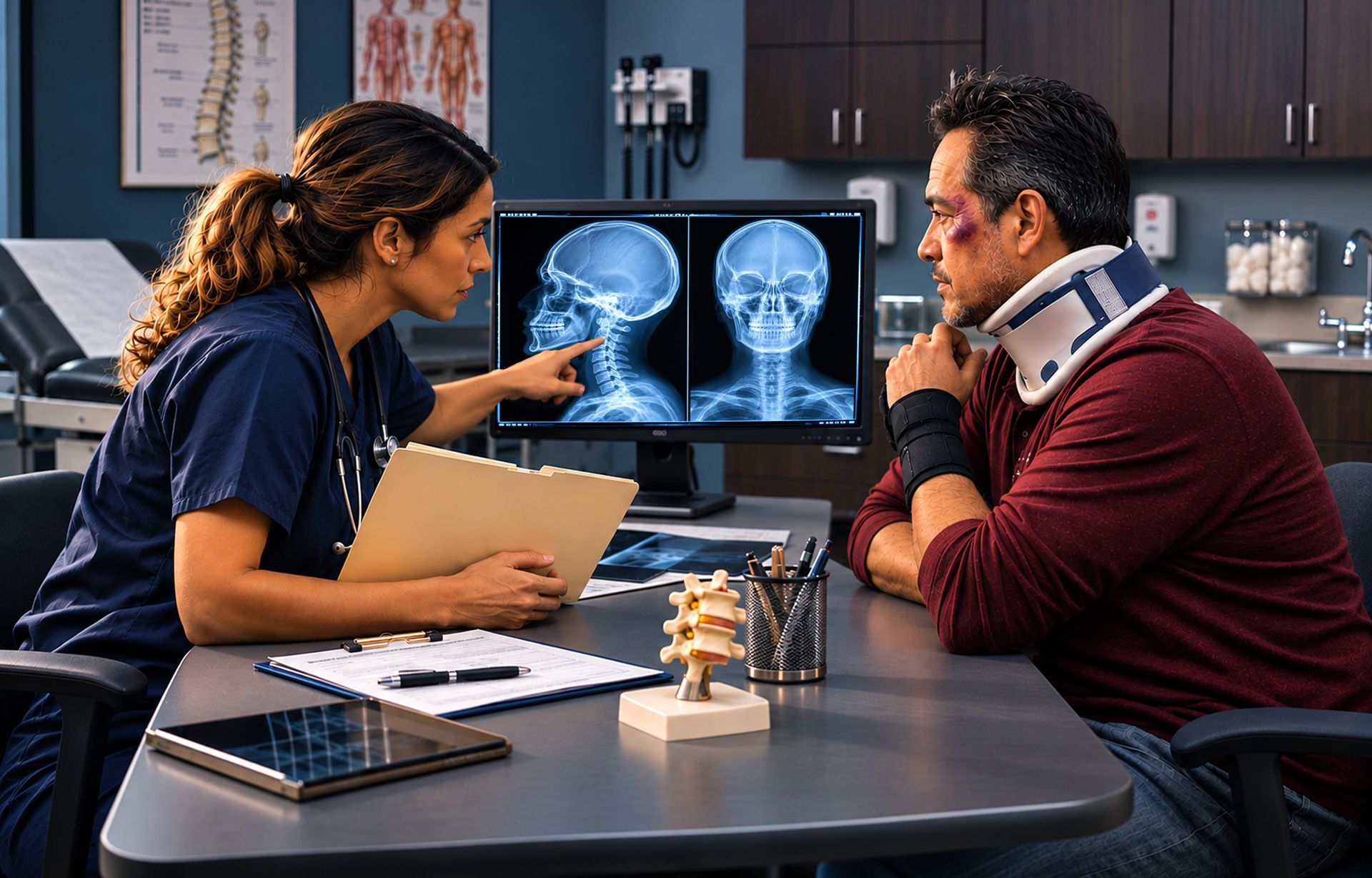
Medical records help document the nature, severity, and consequences of injuries claimed after a car accident. They can also help explain whether the collision caused a new injury or aggravated an existing condition.
Their value comes from the medical history, examination findings, treatment timeline, and professional assessments, not simply the fact that treatment occurred after the crash.
- Emergency department or ambulance records: Initial symptoms, observations, and treatment.
- Examination notes and diagnoses: Reported symptoms, clinical findings, and the provider’s assessment.
- Imaging reports and diagnostic tests: Findings relevant to identifying or evaluating an injury.
- Specialist evaluations: Further assessment of the condition, its possible cause, and treatment needs.
- Physical therapy and rehabilitation records: Functional limitations, treatment, and progress.
- Written work restrictions: Tasks or work activities limited by the injury.
- Treatment plans and medical opinions: Expected care, recovery, and ongoing limitations.
For example, imaging may identify an abnormality, but the finding alone may not explain when it developed or whether the collision caused it. Medical history, examination findings, and a provider’s assessment may be needed to interpret its significance.
Keep clinical records as well as bills. A bill documents a charge, while the associated treatment records help explain what care was provided and why. The Texas Department of Insurance recommends retaining medical records and bills after a wreck .
Symptom Timelines and Treatment History
A timeline can help organize when symptoms were first noticed, when they were reported, and how they changed. It should reflect the records and your actual recollection, not an attempt to make every date appear perfectly consistent.
If there were delays or interruptions in treatment, preserve relevant information explaining them. A gap should be evaluated in context rather than assumed to decide whether an injury is related to the collision.
Differences between reported symptoms and clinical findings may also require explanation or further medical assessment.
Preexisting Conditions
Relevant earlier medical records may help distinguish your condition before the collision from changes afterward. If you are claiming that an accident aggravated an existing problem, comparisons between prior symptoms, prior treatment, and post-collision findings may be important.
Provide an accurate medical history rather than omitting an earlier condition. Whether specific symptoms or limitations resulted from the collision may require a medical opinion.
Records Supporting Financial Losses
Financial documentation should identify the loss, its amount, and its connection to the collision. Organizing records by category makes it easier to identify missing support and avoid counting the same expense more than once.
Medical Expenses
Keep itemized bills, receipts, account statements, and relevant payment or insurance records. Match them to the provider and date of service.
A running list can help organize expenses but retain the underlying records. The amount billed is not necessarily the same as the amount legally recoverable, so preserve more than the original invoice.
Lost Wages and Missed Work
A statement that you missed work is more useful when supported by employment and medical records.
Relevant documents may include:
- Pay stubs showing your usual earnings.
- Employer confirmation of missed dates or reduced hours.
- Records of commissions or other compensation affected.
- Documentation of leave used because of the injuries.
- Medical restrictions explaining why particular duties could not be performed.
The records should connect the missed earnings to the claimed injury rather than simply show that income changed.
Self-Employed Income
For self-employed people, lost income may require a combination of business records. Invoices, contracts, bookkeeping records, tax documents, and information about canceled or postponed work can provide context.
A decline in business revenue does not, by itself, explain why the decline occurred or establish the amount of personal income lost. Records should identify the work affected and account for other relevant factors.
Vehicle Damage and Related Expenses
Repair estimates, final invoices, towing bills, rental receipts, and photographs can help document property-related losses. Keep explanations of supplemental repairs or differences between estimates when available.
Separate these records from injury-related expenses so it is clear what each part of the claim includes.
Future Financial Losses
Future treatment needs or reduced ability to earn income require more than a record of past bills and wages. Depending on the circumstances, medical opinions and vocational or financial analysis may be needed to explain the nature and likely extent of those losses.
Distinguish documented recommendations from possibilities that have not yet been evaluated.
How Can You Document Pain, Suffering, and Lasting Limitations?
Not every effect of an injury appears on a bill. Medical records, personal observations, and accounts from others can help describe how pain and physical limitations changed daily life after a collision.
Texas law defines “noneconomic damages” to include physical pain and suffering, mental or emotional anguish, physical impairment, and other nonfinancial losses. Whether damages are recoverable depends on the applicable law and circumstances. See Texas Civil Practice and Remedies Code Section 41.001(12) .
A factual, dated recovery journal can help document:
- Activities you could not complete or needed help performing.
- Sleep interrupted by symptoms.
- Difficulty driving, walking, lifting, or sitting.
- Changes in household or caregiving responsibilities.
- Limits on work, exercise, or recreational activities.
Specific examples are more informative than broad statements. “Needed help carrying groceries upstairs” describes a particular limitation more clearly than “could not do anything.” Entries should accurately reflect your experience, including changes as you recover.
Family members, caregivers, friends, or coworkers may also describe changes they personally observed. Their accounts should distinguish direct observations from information they learned from someone else.
When lasting limitations are claimed, medical assessments can help explain the expected duration of an impairment, future treatment needs, and functional restrictions. Personal observations add context but do not replace medical evaluation.
The purpose of this evidence is to document the nature, duration, and extent of the injury’s effects, not to exaggerate symptoms or assign an arbitrary dollar amount to each difficult day.

When Can Electronic Evidence and Accident Reconstruction Help Explain a Crash?
Some car accident claims involve technical questions that photographs, police reports, and witness accounts do not fully resolve. Electronic records and accident reconstruction may help evaluate competing explanations of how the collision occurred.
Event Data Recorders
An event data recorder, or EDR, captures certain technical vehicle and occupant information for a brief period around a crash. Depending on the vehicle and system, the information may include speed, braking inputs, and restraint-system status.
The National Highway Traffic Safety Administration distinguishes this information from audio or video recordings: an EDR is not a dashcam or a continuous recording of the entire trip.
Available data may help evaluate how the vehicle was operating shortly before impact and whether accounts are consistent with the recorded information.
However, not every vehicle records the same data, and an EDR does not provide a complete explanation of a collision. Accessing and interpreting the information may require specialized equipment, appropriate authorization, and qualified assistance.
Cellphone Records
Cellphone records may be relevant when distracted driving is suspected. Depending on the records available, they may indicate calls, messages, or other activity around the time of the collision.
Their significance must be evaluated carefully. Recorded activity does not necessarily establish who was using the device or whether it contributed to the crash. Access to relevant records may also depend on consent or appropriate legal procedures.
Accident Reconstruction
Accident reconstruction specialists may examine vehicle damage, roadway measurements, photographs, recordings, and electronic data to evaluate how a collision occurred.
Depending on the available evidence, their analysis may help estimate vehicle speeds, evaluate impact angles or braking distances, and explain the sequence of events in a multi-vehicle collision. The conclusions depend on the quality of the underlying information and the assumptions used.
Not every accident requires expert reconstruction. Its usefulness depends on whether a significant technical question remains disputed and whether the available evidence allows a qualified specialist to address it reliably.
How Does Evidence Affect Comparative Fault in Texas?
Evidence can affect both whether an injured person can recover damages and how much they may recover. Texas uses a proportionate-responsibility system for cases governed by Chapter 33 of the Civil Practice and Remedies Code.
Under Section 33.001 , a claimant cannot recover damages if their percentage of responsibility is greater than 50%. If recovery is allowed, Section 33.012 requires damages to be reduced by the claimant’s percentage of responsibility.
For example, if damages are assessed at $100,000 and the claimant is found 20% responsible, the responsibility reduction would bring that amount to $80,000 before other applicable adjustments. At 50% responsibility, recovery is not barred by Section 33.001, but damages are reduced accordingly. At 51%, recovery is barred.
These rules make evidence about vehicle movements, traffic signals, roadway conditions, and driver conduct particularly important when responsibility is disputed.
For example, if the drivers disagree about who entered an intersection against a red light, a recording or a witness with a clear view of the signal may help resolve that specific issue.
An insurer’s proposed allocation of fault should be evaluated against the available facts, not treated as a court finding. If the case reaches trial, Section 33.003 governs the determination of responsibility percentages and requires sufficient evidence before a question about a person’s conduct is submitted to the jury.
How Do Insurance Companies Evaluate Evidence When Determining Compensation?
Insurance companies evaluate claims by examining evidence of responsibility, the relationship between the collision and the claimed injuries, financial losses, and other damages, along with applicable insurance coverage.
The documentation needed depends on the issue being evaluated:
- Responsibility for the collision: Photographs, witness accounts, recordings, police reports, and relevant vehicle data.
- Injuries and treatment: Medical records, diagnostic findings, treatment histories, and medical opinions.
- Financial losses: Employment records, itemized bills, receipts, tax documents, and other financial documentation.
- Future losses: Medical assessments, rehabilitation plans, vocational evaluations, and appropriate expert opinions.
The strength and consistency of the evidence may influence whether an insurer disputes particular injuries or challenges the amount requested. A settlement evaluation may also consider the likelihood of establishing responsibility and damages if the dispute proceeds to litigation.
Substantial documentation does not guarantee agreement on a claim’s value. Disputes may remain about medical causation, necessary treatment, future expenses, or the extent of pain and limitations.
Coverage and policy limits are separate considerations. Evidence may support a claimed loss without establishing that a particular policy covers the entire amount. The Texas Department of Insurance’s auto insurance guide explains different coverage types and limits.

What Happens When Evidence Is Conflicting or Incomplete?
Missing evidence and conflicting evidence present different challenges. A missing photograph may require looking for another source. Conflicting accounts require examining what each source shows and whether it is consistent with other established facts.
The important questions are which facts remain uncertain, whether additional information can address them, and how reliable the available evidence is.
Can a Car Accident Claim Be Supported Without Photographs or Independent Witnesses?
Yes. A claim may still be supported when scene photographs or independent witnesses are unavailable. Driver statements, vehicle damage, police records, recordings, and relevant electronic data may help explain the collision. Medical and financial records separately support the claimed injuries and losses.
Missing evidence can make disputed issues harder to establish, particularly when the drivers give conflicting accounts. The question is whether the available evidence, considered together, supports the legally required elements of the claim, not whether every possible type of documentation is present.
Information That May Help Address Evidence Gaps
When evidence conflicts, the evaluation may include a witness’s opportunity to observe the event, the completeness of a recording, the accuracy of electronic information, and whether an explanation fits the physical evidence.
- No photographs from the scene: Images taken by passengers, witnesses, insurers, repair facilities, or law enforcement.
- Conflicting driver accounts: Witness observations, recordings, physical evidence, and relevant technical analysis.
- A disputed detail in the crash report: Supporting documents, photographs, or information from the investigating agency.
- Questions about whether injuries resulted from the collision: Relevant medical history, examination findings, treatment records, and medical opinions.
- Disagreement about missed income: Employer records, pay history, business documents, and work restrictions.
- Unclear repair costs: Itemized estimates, supplemental assessments, and final repair invoices.
No source should be treated as conclusive simply because it supports one person’s account. These are possible sources of additional information, not guarantees that missing evidence can be recovered or a disagreement resolved. Some records may never have existed, while others may have been deleted or lost.
How Can Important Evidence Be Preserved Before It Disappears?
Preserving evidence involves more than organizing documents already in your possession. Important information may be held by another driver, a nearby business, a vehicle owner, or another organization.
Recordings may be overwritten, electronic information may become inaccessible, and damaged vehicles or components may be repaired or discarded. Identifying potentially important material early can help determine what preservation steps may be appropriate.
Evidence Held by Other Parties
A nearby business may have footage of the collision, while a commercial vehicle operator may possess relevant electronic records or maintenance documents. When potentially important evidence is controlled by someone else, an attorney may send a preservation request identifying the material that should be retained.
A preservation request is intended to prevent loss of the evidence. It does not, by itself, guarantee access to the material or establish that its recipient has a legal duty to preserve everything requested.
What Happens if Relevant Evidence Is Destroyed?
Texas courts address the loss or destruction of evidence through legal principles known as spoliation.
In Brookshire Brothers, Ltd. v. Aldridge, 438 S.W.3d 9 (Tex. 2014) , the Texas Supreme Court explained that a spoliation finding requires a duty to reasonably preserve evidence and an intentional or negligent breach of that duty.
Not every lost recording or discarded document results in a sanction. The court evaluates whether a preservation duty existed, whether it was breached, and what remedy is appropriate. Any remedy must be proportionate to the conduct and resulting prejudice.
Keeping and Organizing Your Own Records
Keep original photographs and recordings, copies of important documents, and a dated record of relevant insurance communications. Preserve complete correspondence rather than isolated excerpts and keep backup copies of electronic files.
A useful file separates:
- Collision and responsibility evidence.
- Medical records and treatment information.
- Bills and other expenses.
- Employment and income records.
- Insurance correspondence.
- Questions, missing items, and disputed facts.
Evidence preservation and legal filing deadlines are separate issues. A recording may disappear long before a lawsuit deadline arrives. Likewise, collecting records or discussing a claim with an insurer does not replace reviewing the deadlines that apply to the case.
Under Texas Civil Practice and Remedies Code Section 16.003 , personal injury lawsuits generally must be filed within two years after the cause of action accrues, subject to exceptions. That period should not be treated as a safe waiting period for preserving evidence.
How Can an Attorney Help Obtain and Evaluate Evidence?
Individuals can collect many important records themselves, but some evidence requires additional investigation, specialized knowledge, or formal legal procedures.
An attorney may help identify which evidence is relevant, determine where additional information may exist, and evaluate whether the available records adequately support responsibility, injuries, and losses.
This work may involve:
- Obtaining crash reports and related records.
- Interviewing witnesses.
- Requesting preservation of recordings or electronic information.
- Coordinating vehicle inspections.
- Reviewing medical and financial documentation.
- Working with qualified experts when appropriate.
- Addressing disputes over access to evidence.
Not every car accident requires extensive expert analysis or litigation. The scope of an investigation should reflect the circumstances, the issues being disputed, and the likely usefulness of additional evidence.
The purpose is to establish an accurate, supportable account of the collision and its consequences. Understanding what the records can establish, where their limitations lie, and when further investigation is needed can help injured individuals make informed decisions about a claim.
This article provides general information about car accident evidence and Texas personal injury law. It is not legal or medical advice for a particular situation.
Every state limits the amount of time you have to file a claim.
Don't Delay.
Contact the Attorneys at Gordon & Elias, LLP Today to preserve your right to a recovery.